
 Deutsch
 English
Berkvens is one of the leading players in the European door industry. Over the decades, this long-established family-owned company, headquartered in Someren, the Netherlands, has evolved from a traditional manufacturer into a provider of comprehensive door systems. Within the Xidoor Group, Berkvens plays a central role and serves the project business in particular with a high level of industrial expertise. Week after week, coated doors, HPL doors, and matching frames are produced here in industrial quantities. At the same time, the company pursues a clear mission: customers should receive not just individual products, but a fully thought-out solution for their construction project.
Anyone entering the plant in Someren, the Netherlands, quickly senses that things are thought through differently here. It’s not about individual products that are mass-produced and shipped out. It’s about spaces, about buildings, about the interplay of function, design, and logistics. Doors are not created in isolation here, but as part of an overall concept that begins long before production and only ends on the construction site. Many customers therefore receive a digital model of their construction project as early as the planning phase, configure every detail, and see in advance how their door choices will look in the finished building. Director of Operations (DOO) Tom van Dijk describes the Berkvens approach as follows: “We actually do everything for the customer. From door configuration through production to delivery to the construction site and even installation. And for that, you need a deep understanding of what really works in a space. For many, a door is just a door, but for us, it’s a complete system that has to fit perfectly.”
Berkvens specializes in the development and industrial manufacturing of interior doors and complete door solutions for residential and commercial construction. Through continuous product innovation, a high degree of vertical integration, and a commitment to offering comprehensive systems from a single source, the company positions itself as a high-performing partner for modern construction projects.
Growing complexity and a dynamic market situation as the starting point
This mindset shapes the entire organization. Berkvens has consciously moved away from traditional mass production and now manufactures a wide variety of models while maintaining high production volumes. In practice, this means that hardly any two doors are identical, yet they must be produced at the same speed at all times. However, this development also brings new challenges. Complexity is increasing, processes must become more flexible, and at the same time, the need for capacity is growing. Meanwhile, Berkvens was still working with older press technology that, while reliable, no longer aligned with the company’s strategic direction. “We had an old BÜRKLE press on which we made all our HPL doors,” recalls van Dijk. “It was actually already on the list for a new investment, and at the same time, we saw that the market was evolving rapidly. So we didn’t want to wait any longer; we wanted to be able to keep pace with the market.”
With the closure of door manufacturer Reinaerdt Deuren, a relatively new and high-performance system became available. It quickly became clear to Berkvens that this offered more than just the purchase of machinery. The goal was to make a technological leap forward while investing sustainably.
Retrofit as a Strategic Lever for Greater Efficiency
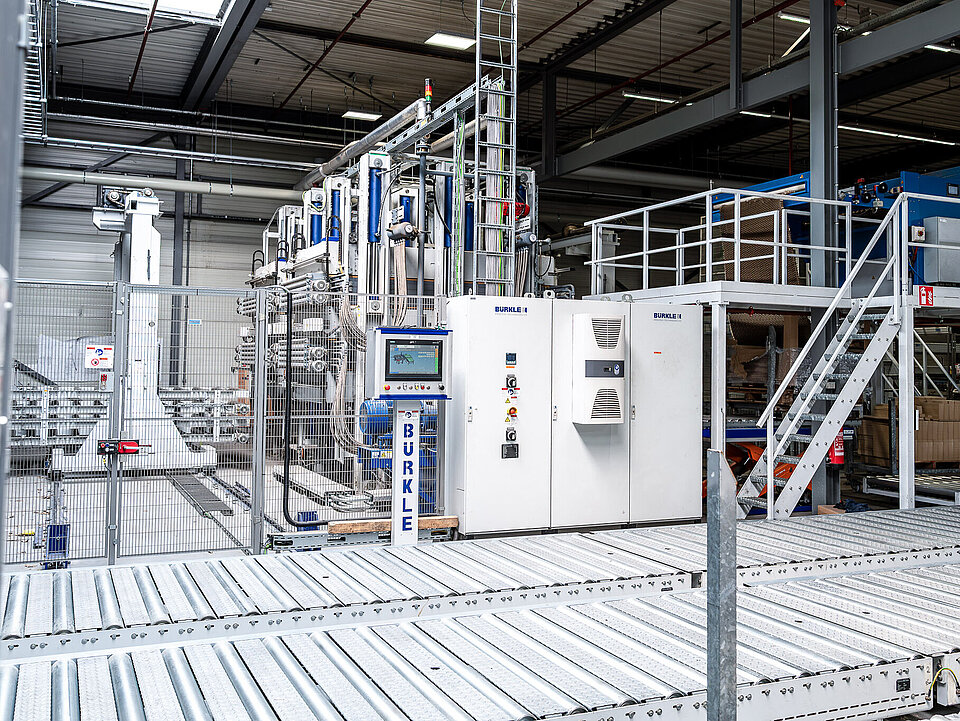
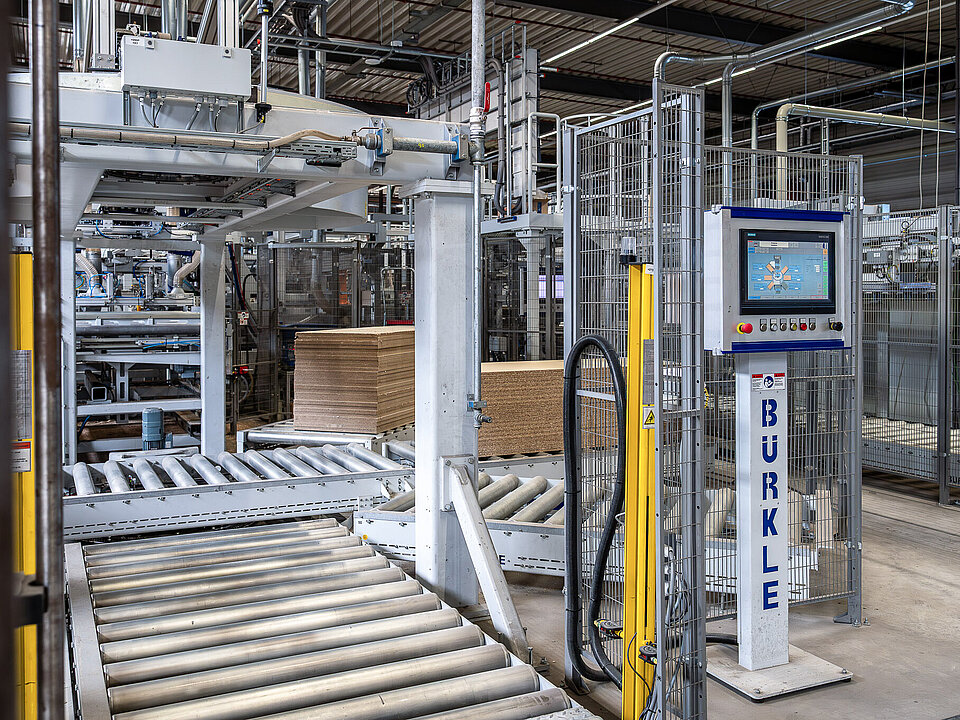
The real added value came from a comprehensive retrofit concept. The machine and plant manufacturer BÜRKLE supported the project from the very beginning, not just as the initial supplier, but as a technical partner. Even before the decision was made, a detailed assessment was conducted. The condition of the plant, technological possibilities, and necessary adjustments were analyzed together. Based on this, a comprehensive plan was developed that went far beyond a simple relocation.
The system was completely dismantled, transported, and reassembled at the new location. At the same time, extensive modifications were made. Programs were revised, interfaces redefined, and mechanical components adapted to Berkvens’ specific door formats. Integration into the existing production system also played a central role.
The collaboration between Berkvens’ production team and BÜRKLE’s service team was particularly intensive. Knowledge had to be rebuilt from scratch, as no staff from the original production team could be retained. “It was clear from the start that we couldn’t take on any staff from Reinaerdt,” says van Dijk. “We worked on-site for a week, but that’s actually far too short for a system like this. That’s why it was important that we rebuilt this knowledge together with BÜRKLE.”
At the same time, the system was upgraded to a new digital standard. Berkvens is among the first users of an expanded service platform that not only enables remote access but also documents and makes all service cases analyzable. This creates a new level of transparency and a foundation for long-term optimization.
Greater Efficiency During Operation
Today, the success of this holistic approach is clearly evident. The system is firmly integrated into production and makes a tangible contribution to the plant’s performance. The situation has changed fundamentally, particularly in the HPL sector. Where a single, older press once dictated production, there is now a modern line that enables higher output, better quality, and significantly greater flexibility.
Efficiency has also improved considerably. Processes that previously required eight to nine employees per shift can now be carried out by just two people. For Berkvens, this means not only a reduction in costs but, above all, a sustainable safeguard of production capacity in a tight labor market.
The initial phase was challenging. Time constraints, the transfer of technical knowledge, and fine-tuning the details were part of our daily routine. But it was precisely during this phase that the strength of the partnership became apparent. “We had a very open collaboration from the very beginning,” van Dijk summarizes. “Of course, there were moments when we had to fight against the clock. That’s normal with a project like this. But what matters is how you handle it. And in that regard, we had excellent support from BÜRKLE, especially during the ramp-up phase.”
A project that delivers economically and strategically
In the end, what matters most to Berkvens is the result. The system is running stably, capacity is increasing continuously, and the economic goals have been achieved. “For us, it was crucial that we had a clear business case and that the numbers added up in the end,” says van Dijk. “BÜRKLE kept its promises, and we stayed within the budget. When you see that and look at the production development at the same time, you can say that the project was truly worth it.”
Thus, the retrofit project is far more than a technical implementation. It is an example of how existing resources, innovative production concepts, and close partnerships can be combined into a sustainable solution. For Berkvens, it is another step toward a production process that harmonizes flexibility, efficiency, and customization.