 Deutsch
 English
A real gem for door manufacturing
For over 70 years, Swiss door manufacturer Brunex has been producing made-to-measure interior and exterior doors, combining tradition and craftsmanship with innovative technology. Just under 100,000 wooden doors are manufactured each year by the company’s approximately 75 employees. The company was founded in early 1954 as the mechanical manufacturing firm Türenfabrik Brunegg AG in the canton of Aargau. Since then, significant investment has been made in the site, the quality of the products and the trust of customers and partners. Today, the family-run company Brunex is regarded in Switzerland by planners, the timber trade and joiners as the epitome of doors and door systems, with and without additional functions. The export share to the two neighbouring countries, Germany and Austria, stands at around 5%.
A key aspect of the entire door manufacturing process in Brunegg is the resource-efficient use of regional materials and an appreciation of wood as a raw material. Today, numerous door variants are made from FSC®-certified wood and carry an eco-label. In this way, Brunex aims to provide carpenters and architects with straightforward proof of the products’ sustainability, health benefits and environmental credentials. For its efforts in the field of sustainability, the manufacturer has been honoured with the SME Sustainability Award, amongst other accolades.
A particular emphasis is placed on sustainable and resource-efficient production processes as well as the continuous development of manufacturing operations. Through targeted investments in modern technologies and efficient production workflows, the company creates the foundation for high-quality products and attractive workplaces. With its customised door solutions and extensive industry expertise, Brunex is regarded by architects, joiners and timber merchants as a reliable partner for demanding construction projects.
Modernization of door production
When Martin Eisele, CEO, and Adolfo Minnig, Production Manager at Brunex, walk through the company’s production hall in Plant 1 today, they are proud of what they have achieved. Proud and happy, because in spring 2025 a new door production line from Robert Bürkle GmbH began operations, marking an important step for the company towards modern door manufacturing with highly attractive workplaces.
In the past, the company – founded in 1954 – still required physically demanding manual labour on the multi-stage press in some cases. But now, with the new press system, Brunex has literally ushered in a new era in terms of ergonomic improvements to working conditions.
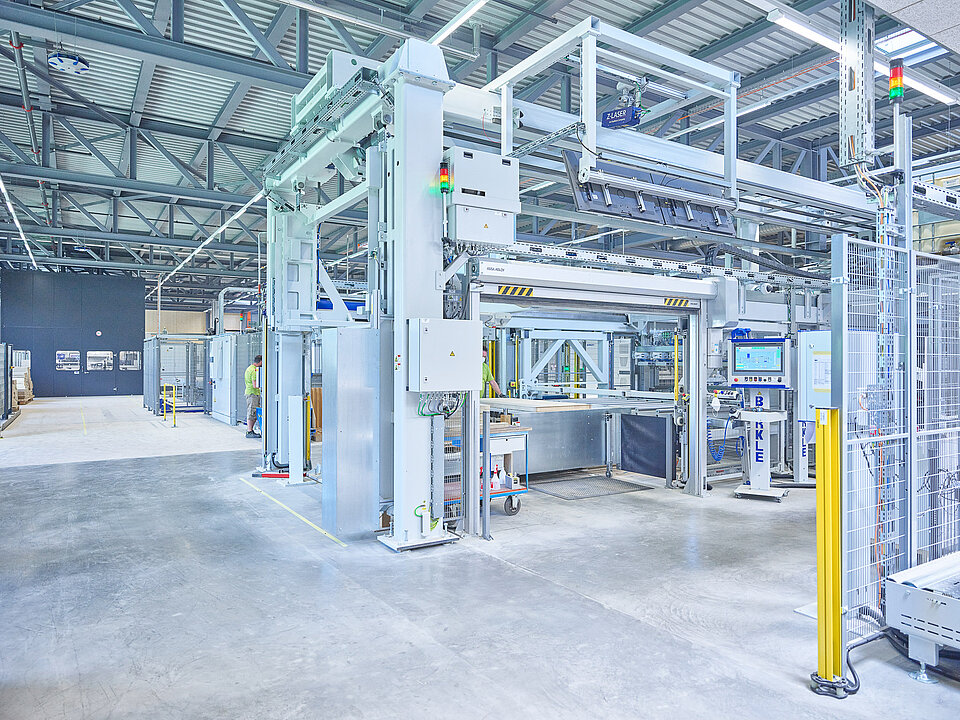
It took just under two years from the initial idea to the commissioning of the new press. Implementation was not always straightforward, as the challenge was to integrate a high-tech system into an existing hall and operational process equipment. The existing hall at Plant 1 was extensively refurbished and brought up to the latest energy standards whilst operations continued. The centrepiece of the Bürkle system was hoisted through the open roof using a mobile crane. This was a major challenge for everyone involved, emphasises Carsten Henkenjohann, Bürkle’s project engineer for fully automatic door production systems.
Under optimal spatial conditions, door production processes are nowadays typically built out lengthways. “But at Bürkle, every system is unique and is always designed to meet the customer’s specific requirements and the constraints of the available space. Nothing here is off-the-shelf,” says Carsten Henkenjohann.
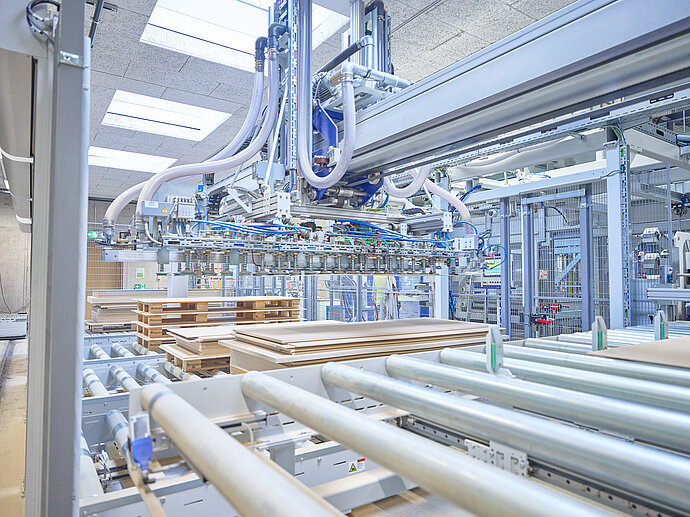
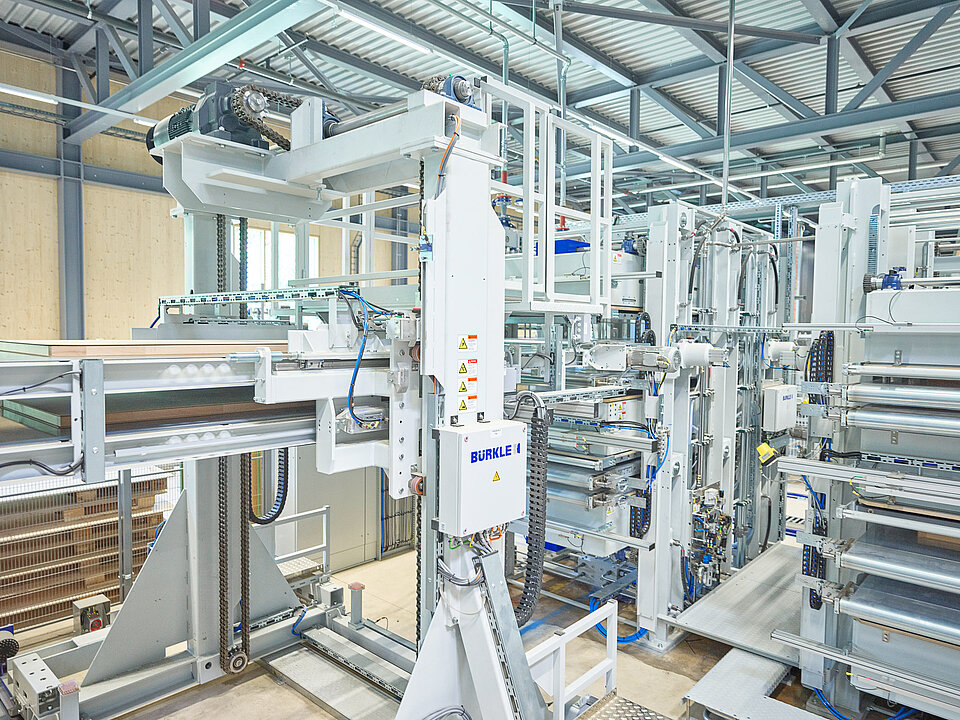
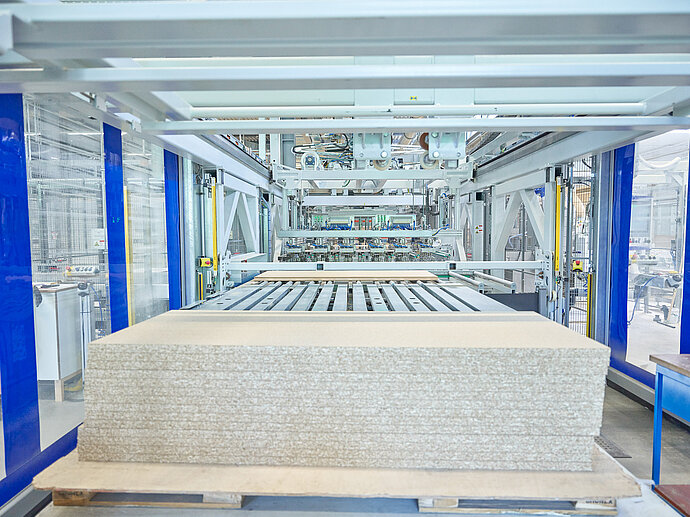
At Brunex, this meant that the system, featuring two presses, had to be built outwards in width and height. The length is just 36 metres, whilst the width is 18 metres. Each of the two presses weighs 35 tonnes. Extensive structural calculations were required due to the necessary floor load, as the system is situated on a floor slab. Each press has two chambers, each with two levels, meaning a total of eight levels are available, allowing different door blanks to be pressed simultaneously. The door blanks have a maximum length of 2,800 mm, a width of up to 1,300 mm and a maximum thickness of 100 mm. As Brunex manufactures many special-purpose doors, a single element can easily weigh over 200 kg.
Improvement of working conditions
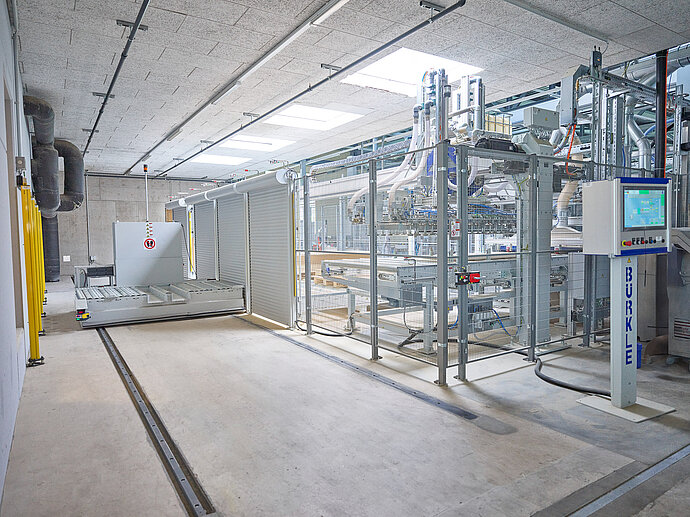
Today, the two operators of the system only insert the core layers manually into the frame, following a specified layout pattern depending on the requirements of the door blank. On their way to the press, the core layers are automatically coated on the top and bottom with the respective coatings and then pressed together under pressure and heat using the adhesive previously applied to the cover plates. In some cases, additional surface materials such as veneers or HPL are added. Whilst the assembly into a door blank often takes just under a minute, the blank remains in the press for several minutes, depending on the door construction. The element then leaves the press, is cooled via a paternoster and subsequently sent to the relevant CNC machines for further processing.
In the past, loading the old presses involved heavy manual labour in some cases, as operators had to bring both the blanks and the door leaves together by hand before finally feeding them into the presses.
“Our primary aim was therefore to create ergonomically optimal and attractive workstations for our employees with the new press system, where they now have virtually no physically demanding work to carry out. This was even more important to us than increasing production,” says Adolfo Minnig, outlining the requirements. With the new system from Bürkle, precisely these objectives were achieved. Depending on the order intake, the system can press around 480 doors per shift. “Even though increasing output wasn’t necessarily the main focus for this project, we were of course able to significantly increase flexibility compared to the previous system, so that if required, production capacity can be increased without any issues whilst maintaining the same quality,” says Carsten Henkenjohann, describing the approach.
Engineering – Expertise as a Decisive
Factor A key challenge in the planning and implementation of the system was to keep downtime as short as possible. For Bürkle, this meant that the presses and other system components, such as the sophisticated stacking system, were fully assembled and tested using specified data at the two Bürkle production sites in Mastholte and Freudenstadt before on-site installation. “We wanted to rule out any unpleasant surprises on site from the outset that might have led to a delay in the installation. Based on this simulation, commissioning was then completed in just a few weeks following the re-installation at Brunex early last year. Not least, this is also thanks to the highly experienced team that was deployed for the job,” says Carsten Henkenjohann. Even though the roof of the building had to be briefly raised and elevated in parallel with the installation, this did not cause any delay. The plant has been operating normally since around Easter last year. Martin Eisele and production manager Adolfo Minnig had already convinced themselves in advance, through real-world tests, that Bürkle could actually meet the set targets. “We knew that the site conditions here were challenging. It was certainly no ‘open-heart surgery’, but the task was to commission a new, state-of-the-art and complex plant within a few weeks and integrate it seamlessly into existing processes. At the same time, we wanted to achieve the desired improvements in workflow. The entire Bürkle team did a truly outstanding job here,” summarise Martin Eisele and Adolfo Minnig. Even during the installation, the operators familiarised themselves with the new Bürkle system and got to know the intuitive menu control so that they could operate the system independently practically from the very first day of production. And should any unexpected problems arise, the experts from Bürkle connect via remote maintenance and work with the operators to find a solution. It is precisely this positive and trusting experience that has ultimately led Martin Eisele to refer to the door production line today as the new jewel in the crown of Brunex’s production.