 Deutsch
 English US
IKEA Industry Sopron is one of the most important production sites within the IKEA Group in Europe. Located in Sopron, Hungary, the facility employs around 900 people and manufactures kitchen fronts as well as fronts and doors for living room and bedroom furniture on a production area of more than 86,000 square meters. With a production capacity of up to 70,000 furniture fronts per week, the plant relies on state-of-the-art manufacturing technologies to ensure the highest quality standards while making efficient use of resources. Continuous improvements in productivity, occupational safety, and sustainability play a key role in achieving these objectives.
Against this backdrop, IKEA Industry Sopron faced the challenge of future-proofing an existing coating line commissioned in 2008. The existing infeed and destacking solution could no longer fully meet the increasing demands for performance, flexibility, and process reliability. In particular, the processing of textured furniture panels and varying product formats repeatedly led to limitations in the material flow. In addition, product changeovers regularly resulted in downtime, as the line first had to be completely emptied. At the same time, the objective was to increase line capacity while further improving the quality of the surface finishing process.
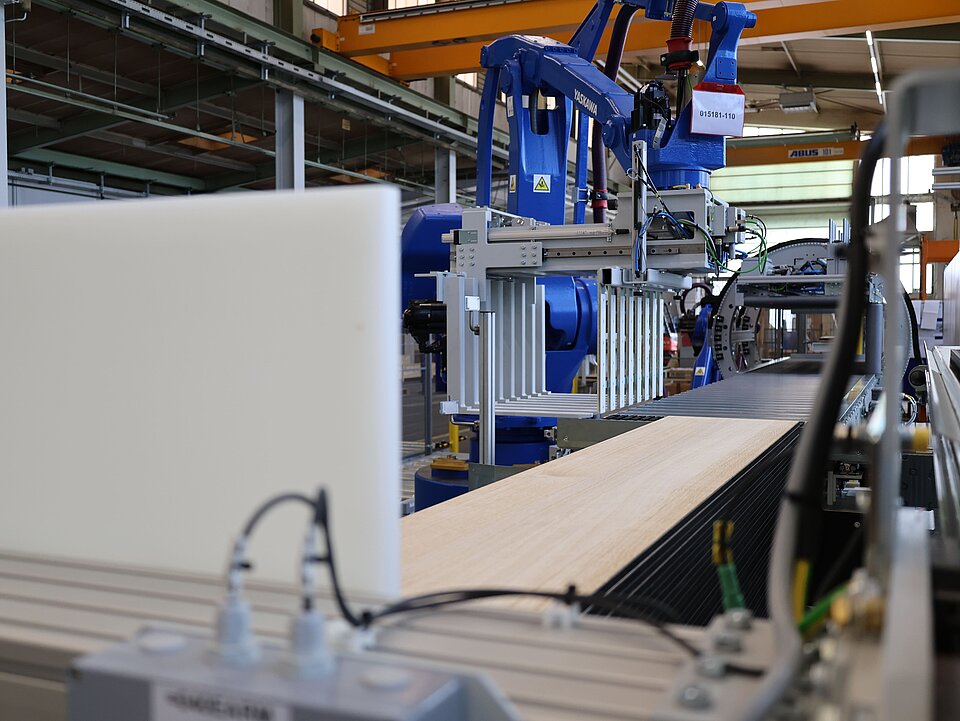
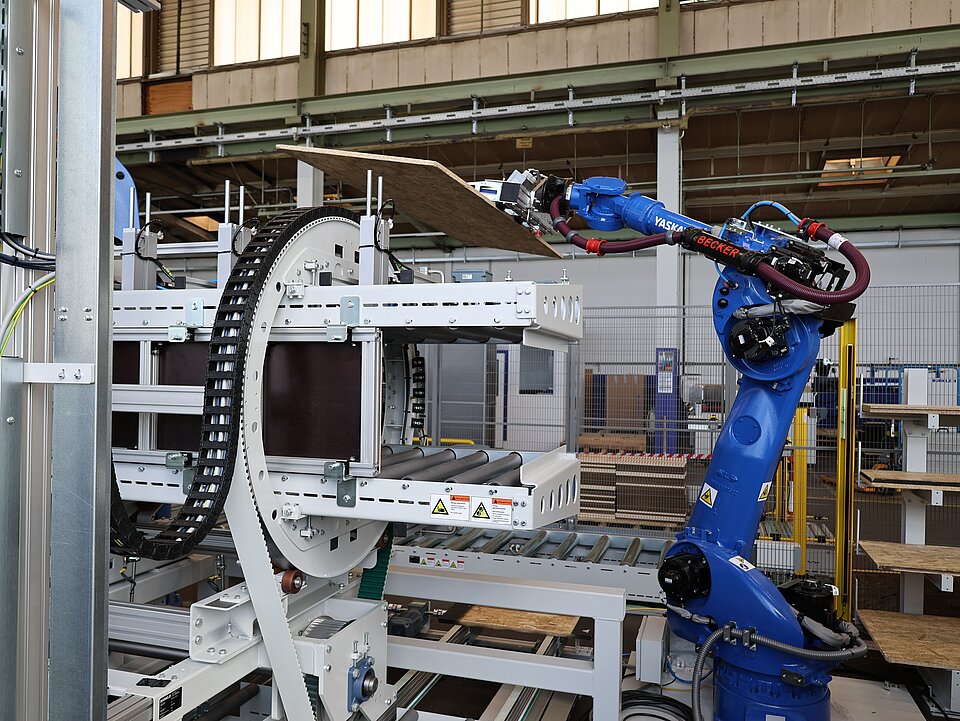
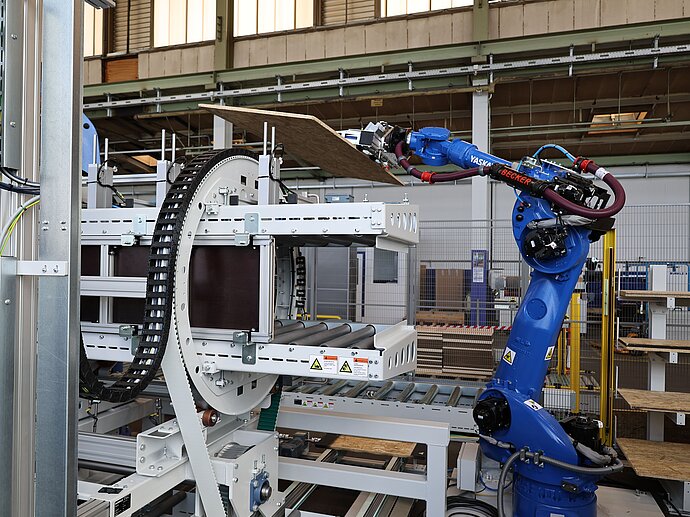
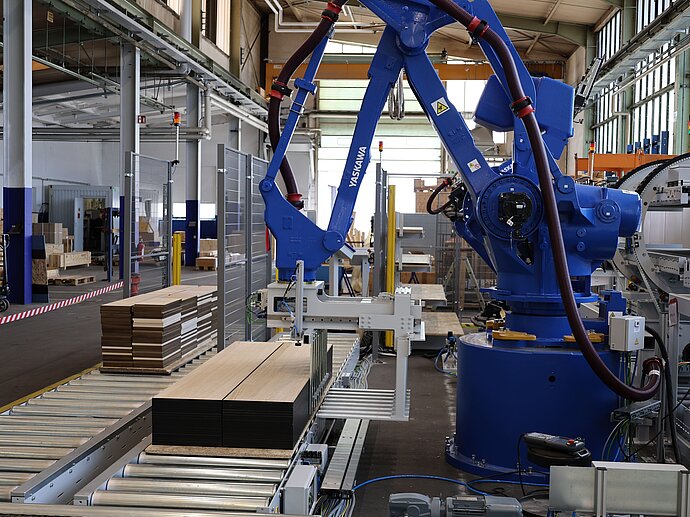
Together with IKEA Industry, BÜRKLE therefore developed a comprehensive retrofit and automation concept for the existing coating line. At the heart of the solution is a new high-performance automated infeed and destacking system based on a dual-gantry design. The system takes the workpieces from the incoming stacks, automatically aligns them, and precisely spaces them apart during transport. This creates the required distance between individual workpieces to ensure uniform coating and complete processing of all edges and surfaces. At the same time, the solution was specifically designed to process demanding textured furniture panels. Despite the significantly expanded functionality, the entire automation system was successfully integrated into the existing footprint of the production line.
In addition, BÜRKLE implemented a continuous product tracking system throughout the entire line. As a result, every panel can now be clearly identified and tracked at any time. Product changeovers can now be carried out without completely emptying the line. Different workpiece thicknesses can be processed consecutively, while the machines involved automatically adjust to the respective parameters. This significantly increases production flexibility and reduces unproductive downtime.
The success of the project led IKEA Industry to commission a further automation step. In a follow-up project, the previously manual stack formation process ahead of the coating line is currently being automated. In the future, two robots will create complex stacking patterns from the individual workpieces, providing the basis for a fully automated material flow all the way into the coating line.
The modernization offers numerous benefits for IKEA Industry Sopron. Line capacity has been increased from ten to twelve cycles, corresponding to an increase in production capacity of approximately 20%. At the same time, the new automation significantly improves process stability and reduces disruptions during operation. Improved workpiece separation enhances coating quality, while the integrated product tracking system enables faster product changeovers and more flexible production planning. In addition, manual tasks have been reduced, relieving four employees from ergonomically demanding handling operations. The personnel resources freed up in this way can now be assigned to more value-adding activities.
The project in Sopron clearly demonstrates how existing production systems can be sustainably upgraded through targeted retrofit and automation solutions. Instead of replacing proven equipment entirely, the existing infrastructure was intelligently modernized and adapted to today's production requirements. For IKEA Industry, this means a more efficient, more flexible, and future-proof production environment. For other furniture manufacturers and industrial producers, the project highlights the significant potential of modernizing existing production lines, particularly when higher performance, greater flexibility, and cost-effective implementation are equally important.
"The IKEA Sopron project is a prime example of how existing production systems can be elevated to a new level of performance with the right automation concept. Despite limited installation space, we succeeded in implementing a solution that combines higher capacity, improved process stability, and maximum flexibility. The result is a future-ready production environment that meets the growing demands of the furniture industry. The fact that IKEA Industry is continuing this path with additional automation projects is the greatest confirmation of our shared success," says Karl-Heinz Gude, Automation Project Manager at BÜRKLE.