Bürkle is currently investing in the modernization of its Freudenstadt facility and the construction of a new factory there. What are the reasons behind this, and what is the timeline?
Through the comprehensive modernization of part of the facility and the construction of a new building on the company grounds, we are sending a clear signal of our commitment to strengthening our headquarters for the long term. We are creating the structural and technological conditions necessary to continue successfully meeting the demands of global markets in the future. Construction work will begin shortly, with completion scheduled for the end of 2027. With this investment in the single-digit millions, we aim to provide our 170 employees at the site with state-of-the-art and future-proof workplaces.
Was building on a greenfield also considered?
This possibility certainly played a role at the beginning of our discussions. However, we ultimately decided to renovate the existing site. This, by the way, also pleases our employees, who can remain in their familiar surroundings. We will completely renovate the existing plant on the premises and equip it with state-of-the-art technology. The new factory will be directly adjacent to it. This will create a unified facility with very short distances, which is why we will also generate increased productivity.
How does this investment fit into Bürkle’s overall strategy, given the construction projects at various locations around the globe?
In recent years, we have focused heavily on expanding our locations outside of Germany and Europe. For example, we had new construction projects in China and Hungary that required our attention and tied up resources. Our home location, on the other hand, had been waiting for modernization for quite some time, which is why we are now taking a major step forward.
How are global markets in the furniture production sector developing from Bürkle’s perspective?
During the pandemic, there was a great deal of investment in Asia. As a result, there is now overcapacity in panel processing there—and the Chinese are supplying the rest of the Asian markets with their furniture. Imports to Europe are also rising rapidly. Added to this are geopolitical developments, including the war in Ukraine, U.S. tariff policies, and post-COVID effects on furniture consumption. All of this naturally weighs on sentiment. We are currently experiencing a global recession in the furniture sector.
Are there any markets that are still performing relatively well?
Southern Europe is performing better than other regions in Europe. This is particularly because our Southern European customers often supply export markets in North Africa. We see growth there, albeit at a low level. Things are also going relatively well in the Middle East, where increased investment is taking place. The goal of this investment is to reduce imports of furniture and building products and to produce locally. I also see potential in Eastern Europe, in the countries bordering Ukraine. If the war hopefully ends soon, the focus will shift to rebuilding the country, which should certainly give the construction and furniture industries a boost.
Germany continues to be seen as the problem child among the markets. Do you see it that way too? And what role does the domestic market play for Bürkle?
Our market share in Germany is among the highest, but Bürkle’s dependence on the German market is low. We have always been strongly export-oriented. At the moment, we see few positive signs in Germany—with the exception of the door industry. In the area of new construction, our country is actually one of the laggards in Europe.
Bürkle is currently driving the expansion of its global dealer network. What exactly have you planned, and which countries are you targeting?
We launched in North America about two years ago with a reorganization of the sales team. Since then, our regional CEO has built a comprehensive dealer network—from Canada through the U.S. to Mexico. The blueprint is in place—now it’s time to roll it out. Our “Easy to Sell” package is designed to make it simple for dealers to sell the sometimes complex Bürkle product portfolio. We are very confident that this will allow us to take a major step forward. We are now implementing a similar approach in Europe. In Switzerland and the Benelux countries, we are working very successfully with new partners. We have also hired our own sales representative in Spain. We are also strengthening our existing team in the Middle East. Furthermore, we plan to expand into additional countries in Southern Europe and North Africa this year.
What role does the skilled trades sector play for Bürkle, and what are your expectations for the Holz-Handwerk trade fair in Nuremberg?
The crafts sector is becoming increasingly important to us. Two years ago, we began focusing our product range more strongly on the needs of carpenters and joiners. This process is now complete, and we are very excited to present our expanded product portfolio to industry professionals for the first time in Nuremberg. Holz-Handwerk is the ideal trade show for us to engage directly with the trade community in a practical and collaborative manner.
What will Bürkle be showcasing at Holz-Handwerk?
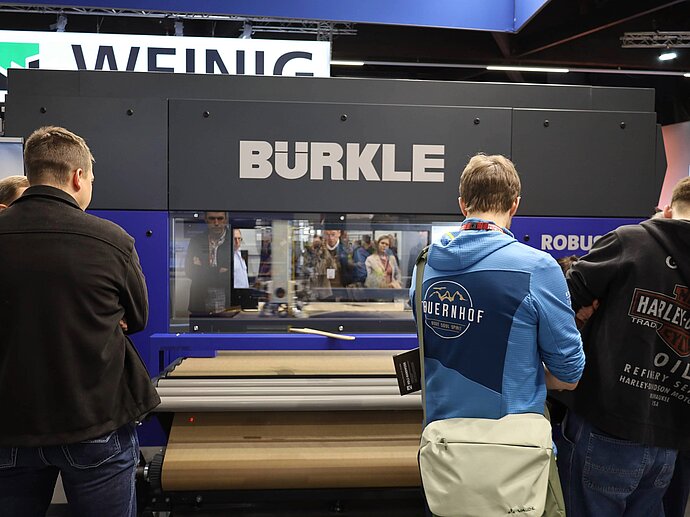
The focus of our trade show presentation is on high-performance yet cost-effective coating systems. These include the “Robus Eco” spray coating machine and the “KA” roller coating UV system. In addition to live demonstrations of coating technology, we will also showcase our PUR and adhesive application machines, as well as selected continuous press systems specifically designed for small to medium-sized production capacities. This allows us to cover a wide range of applications, from classic film and veneer coating to sophisticated coating solutions.

 Deutsch
 English US